
The Kachipo, also known as Suri or Surma in Ethiopia, is a fascinating indigenous community residing in the Boma Mountain range with their headquarters at Meiwun near South Sudan-Ethiopian border. Known for their unique cultural practices and distinct way of life, the Kachipo people have managed to preserve their traditions and customs throughout history. The Suri tribe boasts a rich and vibrant culture that is deeply rooted in their beliefs and values. They have a strong sense of community and are organized into clans, with each clan comprising several extended families. Family ties are of utmost importance in Suri society, and they play a crucial role in daily life and decision-making processes. Another prominent aspect of their culture is body painting and scarification, which holds great significance for both men and women. Men engage in intricate scarification patterns on their bodies, while women display intricate body paintings that vary in design and color. This decorative body art is not only a form of expression but also represents bravery, beauty, and social status within the community. Social life among the Suri is primarily centered around the village communities they inhabit. These villages are often made up of huts or houses, typically constructed using locally available materials such as mud, wooden poles, and thatch roofs. The huts are arranged in a circular pattern, with each clan occupying a separate section of the village. This spatial arrangement promotes a sense of togetherness and facilitates communal activities. The close-knit clan structures are organized into smaller groups called "tumas" and each tumas has its own leader, who acts as the patriarch and makes decisions on behalf of the group. These leaders play a vital role in maintaining social harmony and resolving conflicts within the community. Additionally, marriages are significant events within the Suri tribe and serve as a means of strengthening social ties between families. These ceremonies are celebrated with grand festivities, including dances, singing, and the exchange of dowries. Economically, the Suri tribe relies heavily on agriculture and animal husbandry. They cultivate fields and grow crops such as sorghum, maize, and millet, which form the staple of their diet. Livestock, particularly cattle, also hold significant economic value for the Suri people. They engage in pastoral activities, rearing cattle for milk, meat, and trade. Cattle are regarded as a measure of wealth and status, and they play a crucial role in social and economic exchanges within the community. One of the most distinctive practices of the Suri tribe is facial and body scarification. Scarification is considered an important form of decoration and a symbol of beauty within the community. Both men and women undergo this process, which involves making intricate patterns of scars on the skin using sharp objects. These scars are often seen as a rite of passage, marking important life events such as reaching adulthood, marriage, or achieving a high social status. Scarification also serves as a means of identity and differentiation among different clans and tribes. In addition to scarification, body piercing is another common practice among the Suri. The women of the tribe, in particular, are known to adorn themselves with lip plates. Lip piercing is done by cutting a slit in the lower or upper lip and inserting a gradually increasing circular lip plate. This practice is not only a form of personal adornment but also symbolizes female beauty and is often associated with fertility and marriageability. The dressing style of the Suri people showcases their distinctive identity. Both men and women typically wear minimal clothing, with men donning a loincloth made of animal skins and women wearing skirts made of woven materials. Accessories such as beaded necklaces, bracelets, and anklets are commonly worn, adding a touch of color and vibrancy to their overall appearance. The architectural style of Suri villages is characterized by the use of locally available materials. The circular huts, as previously mentioned, are constructed using mud, wood, and thatch roofs. These traditional dwellings are designed to safeguard against the elements and enhance communal living. The Suri people have a deep respect for nature and their surroundings, which is reflected in the sustainable architecture of their villages.
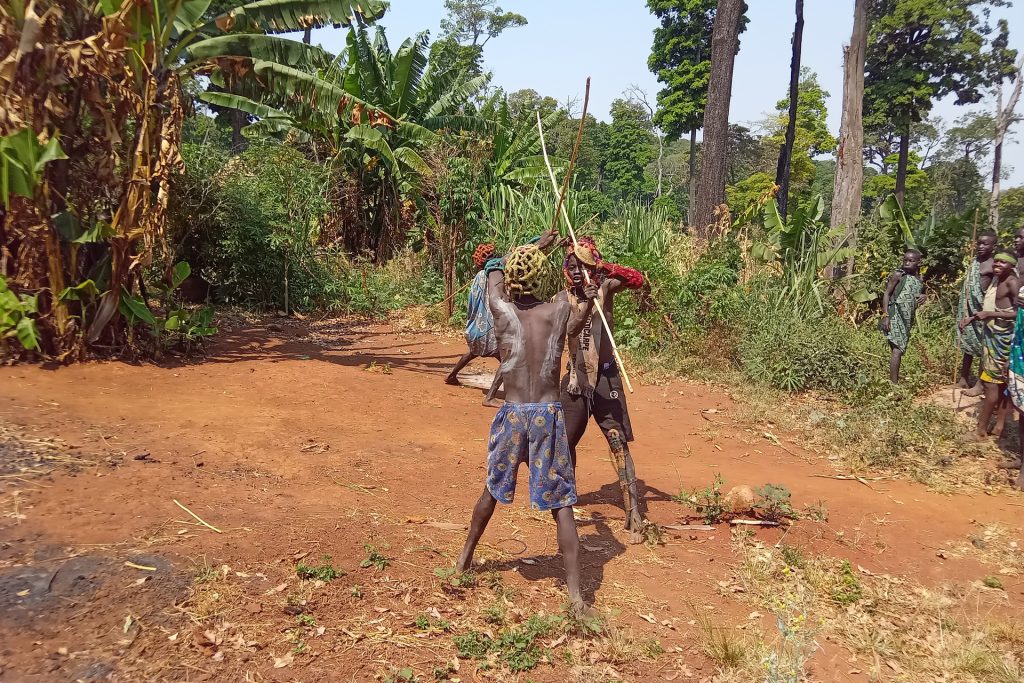
Stick fight: Dominant Cultural Practice among Kachipo The Kachipo stick fighting, also known as Donga or "the stick game," is a traditional sport practiced by the Suri people, an ethnic group inhabiting the southwestern region of Ethiopia. It is an integral part of their cultural heritage and serves as a way to settle disputes, uphold traditions, and showcase physical strength and bravery. In Suri stick fighting, participants, typically young men, engage in bouts of combat armed only with long sticks. The objective is to strike the opponent's body with force while simultaneously avoiding being struck oneself. The fighters exhibit exceptional agility, quick reflexes, and coordination to evade their opponent's attacks. The use of shields or protective gear is minimal, emphasizing the display of skill, courage, and endurance. The Suri stick fight is not just a physical contest but also a social event that brings together the community. It is often accompanied by vibrant music and dance performed by the women, who cheer and encourage the fighters throughout the matches. Spectators gather to witness and celebrate the matches, which can be both competitive and ceremonious. This traditional sport holds deep cultural significance for the Suri people. It acts as a rite of passage for young men, marking their transition from adolescence to adulthood. Stick fighting allows them to prove their strength and establish their reputation within the community. It also serves as a means of resolving conflicts and disputes peacefully, as fighters demonstrate their skills rather than resorting to violence. In recent years, Kachipo stick fighting has gained attention, attracting tourists and researchers interested in traditional games and indigenous cultures.
Stick fight: Dominant Cultural Practice among Kachipo The Kachipo stick fighting, also known as Donga or "the stick game," is a traditional sport practiced by the Suri people, an ethnic group inhabiting the southwestern region of Ethiopia. It is an integral part of their cultural heritage and serves as a way to settle disputes, uphold traditions, and showcase physical strength and bravery. In Suri stick fighting, participants, typically young men, engage in bouts of combat armed only with long sticks. The objective is to strike the opponent's body with force while simultaneously avoiding being struck oneself. The fighters exhibit exceptional agility, quick reflexes, and coordination to evade their opponent's attacks. The use of shields or protective gear is minimal, emphasizing the display of skill, courage, and endurance. The Suri stick fight is not just a physical contest but also a social event that brings together the community. It is often accompanied by vibrant music and dance performed by the women, who cheer and encourage the fighters throughout the matches. Spectators gather to witness and celebrate the matches, which can be both competitive and ceremonious. This traditional sport holds deep cultural significance for the Suri people. It acts as a rite of passage for young men, marking their transition from adolescence to adulthood. Stick fighting allows them to prove their strength and establish their reputation within the community. It also serves as a means of resolving conflicts and disputes peacefully, as fighters demonstrate their skills rather than resorting to violence. In recent years, Kachipo stick fighting has gained attention, attracting tourists and researchers interested in traditional games and indigenous cultures.


